Evaluating the Heart Ceramic Ornament Mockup PSD PNG for Professional Design Presentations
In the competitive landscape of digital product design and e-commerce, the visual presentation of a concept often carries as much weight as the design itself. For creators specializing in seasonal decor, wedding stationery, or personalized gifts, finding the right vehicle to showcase work is critical. The Heart Ceramic Ornament Mockup PSD PNG represents a specific category of digital asset designed to bridge the gap between a flat digital file and a tangible, photorealistic product. Understanding what this tool offers, how it compares to alternative presentation methods, and where it fits within a broader design workflow is essential for making an informed decision about your resource library.
Defining the Asset: More Than Just a Placeholder
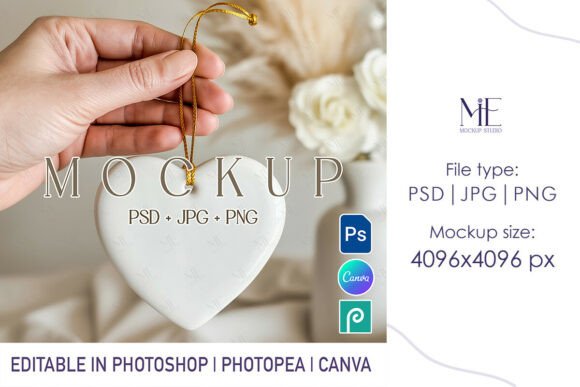
At its core, the Heart Ceramic Ornament Mockup PSD PNG is a high-fidelity digital template. Unlike a standard photograph of a blank ornament, this asset utilizes Adobe Photoshop's Smart Object technology. This distinction is vital for professionals who need efficiency without sacrificing quality. When you engage with this file, you are not merely placing an image on top of a background; you are integrating your design into a complex layer structure that accounts for lighting, shadow, texture, and curvature.
The "V" designation often associated with this style refers to its versatility or specific vector-compatible layers, ensuring that the final output remains crisp regardless of the scale. The inclusion of both PSD (Photoshop Document) and high-resolution PNG formats provides flexibility. The PSD allows for deep customization via Smart Objects, while the PNG offers a ready-to-use, transparent-background option for quick compositing in other software environments. This dual-format approach caters to different stages of the design process, from initial concepting to final marketing asset creation.
Comparative Analysis: Mockups vs. Traditional Photography
When evaluating how to present a ceramic ornament design, creators generally face two primary paths: traditional product photography or digital mockups. Each approach has distinct tradeoffs regarding cost, time, and control.
Traditional Photography requires physical prototypes. You must manufacture the actual ceramic ornament, set up a lighting rig, manage reflections on the glossy surface, and capture the image. While this yields authentic results, it is resource-intensive. It requires inventory management, shipping logistics for samples, and significant post-production editing to remove dust or imperfections. Furthermore, if you wish to show five different color variations of the same heart design, you must physically produce and photograph five separate items.
In contrast, the Heart Ceramic Ornament Mockup PSD PNG eliminates the need for physical production during the visualization phase. The strengths here are immediate:
- Cost Efficiency: There is no need to pay for manufacturing samples or hire a photographer.
- Speed: Designs can be visualized seconds after completion, allowing for rapid iteration.
- Consistency: Lighting and angles remain perfectly consistent across different design variations, which is crucial for creating cohesive shop banners or social media grids.
However, the limitation of digital mockups lies in their reliance on the quality of the base render. A poor-quality mockup may look obviously digital, with unrealistic shadows or textures that do not match the specific glaze of the actual product. High-quality assets, such as the 4096x4096 resolution files mentioned in premium templates, mitigate this by offering exceptional detail that mimics real-world optics.
Format Considerations: PSD Smart Objects vs. Flat Overlays
Not all mockup templates are created equal. A critical decision factor for users is the technical construction of the file. Some lower-tier resources offer simple "overlay" methods where a design is placed on a layer with a "Multiply" blend mode. While fast, this often fails to account for the curvature of a spherical or heart-shaped object, resulting in a design that looks painted on rather than integrated.
The superior approach found in professional Heart Ceramic Ornament Mockup PSD PNG files is the use of fully editable Smart Object layers. This technology wraps the design around the 3D form of the ornament mathematically. When you double-click the Smart Object layer, insert your artwork, and save, Photoshop automatically distorts and maps the image to fit the contours of the heart shape. It also applies the necessary highlights and shadows inherent to the ceramic material. This ensures that if your design includes text or intricate patterns, they warp naturally around the curve, providing a realistic finish that flat overlays cannot achieve.
Ideal Use Cases and Strategic Applications
Determining whether this specific mockup is the right choice depends largely on your intended application. The heart shape and ceramic texture make this asset particularly well-suited for specific niches:
- Wedding and Event Favors: For designers creating custom tags or ornaments for weddings, this mockup allows clients to visualize the final product before committing to a bulk order. It serves as a powerful sales tool for custom stationery businesses.
- Seasonal Retail Listings: Etsy sellers and independent artists selling Valentine's Day or Christmas decorations can use these images for product listings. Since no physical item needs to be shipped for the photo shoot, new designs can be listed instantly.
- Portfolio Development: Graphic designers can populate their portfolios with realistic product shots even if they have not yet manufactured the physical goods. This demonstrates capability to potential clients without upfront inventory costs.
It is important to note that while these mockups are excellent for digital marketing and client approvals, they are not a substitute for final product photography if the physical item has unique tactile qualities—such as a specific glitter glaze or hand-painted irregularity—that the digital render cannot replicate. In such cases, a hybrid approach is often best: use the mockup for initial launch and advertising, then replace images with real photos once inventory is in hand.
Technical Requirements and Workflow Integration
Adopting this tool requires access to specific software, primarily Adobe Photoshop. The workflow is streamlined but demands a basic understanding of layer management. The process typically involves purchasing and downloading the digital file, opening the PSD, locating the designated Smart Object layer (often highlighted or named clearly), and double-clicking to open the embedded file. Once the user places their design and saves, the main document updates automatically.
The availability of a high-resolution JPG alongside the PSD adds value for users who may not have Photoshop installed but need a high-quality base image for other editing tools, although the full benefits of the Smart Object integration will be lost without the native software. The 4096x4096 resolution ensures that the output is suitable for large-format printing or high-density displays, preventing pixelation when zoomed in.
Making the Decision: Is This Resource Right for You?
Choosing to invest in a specialized mockup like the Heart Ceramic Ornament Mockup PSD PNG comes down to a balance of budget, timeline, and technical comfort. If your primary goal is to rapidly prototype ideas, present concepts to clients professionally, or launch an online store without holding physical inventory, this digital solution offers a compelling advantage over traditional photography.
Conversely, if your brand identity relies heavily on the "handmade" aesthetic where imperfections and texture variations are the selling point, you may find that digital mockups feel too polished or uniform. In those scenarios, these templates serve best as placeholders until real photography can be arranged.
Ultimately, the value of this asset lies in its ability to elevate the perceived quality of your work. By utilizing realistic lighting and accurate material simulation, it allows designers to focus on creativity and strategy rather than the logistical hurdles of product photography. For those navigating the intersection of digital design and physical products, having a reliable, high-resolution mockup library is an indispensable part of a modern professional toolkit.